
Deck Railing Height vs Stair Rail Height in Austin
You are standing on your Austin deck with a tape measure, and the old rail only reaches the middle of your thigh. Before you order posts and balusters, you want the number the inspector will actually check.
On a house deck in Austin, a required guard must stand at least 36 inches above the walking surface. The guard along the open side of a stair can be 34 inches. The handrail you grab on the stairs must sit 34 to 38 inches above the line of the stair nosings.
- A guard is required when the drop is more than 30 inches within 36 inches of the edge.
- Deck guards are 36 inches or taller. Stair guards can be 34.
- No gap in a required guard may pass a 4 inch ball.
- Stairs with four or more risers need a handrail at 34 to 38 inches.
- Replacing only deck boards is exempt in Austin. Rail work is not.
Which Code Austin Enforces
The city's building technical codes page lists the 2024 International Residential Code, with local amendments effective July 10, 2025. The council adopted it in Ordinance 20250410-040. Its local changes cover permits, roofing and a few other sections. None of them amend the guard or handrail sections.
One thing did change in the 2024 book, and it trips people up. The sections moved. In the 2024 edition, handrails are Section R320 and guards are Section R321. Most railing articles still cite R312 and R311.7, the numbers from the 2021 book.
So when an inspector or a plan reviewer names R321, it is the guard section. Do not go looking for R312 in the 2024 book.
When a Deck Needs a Guard
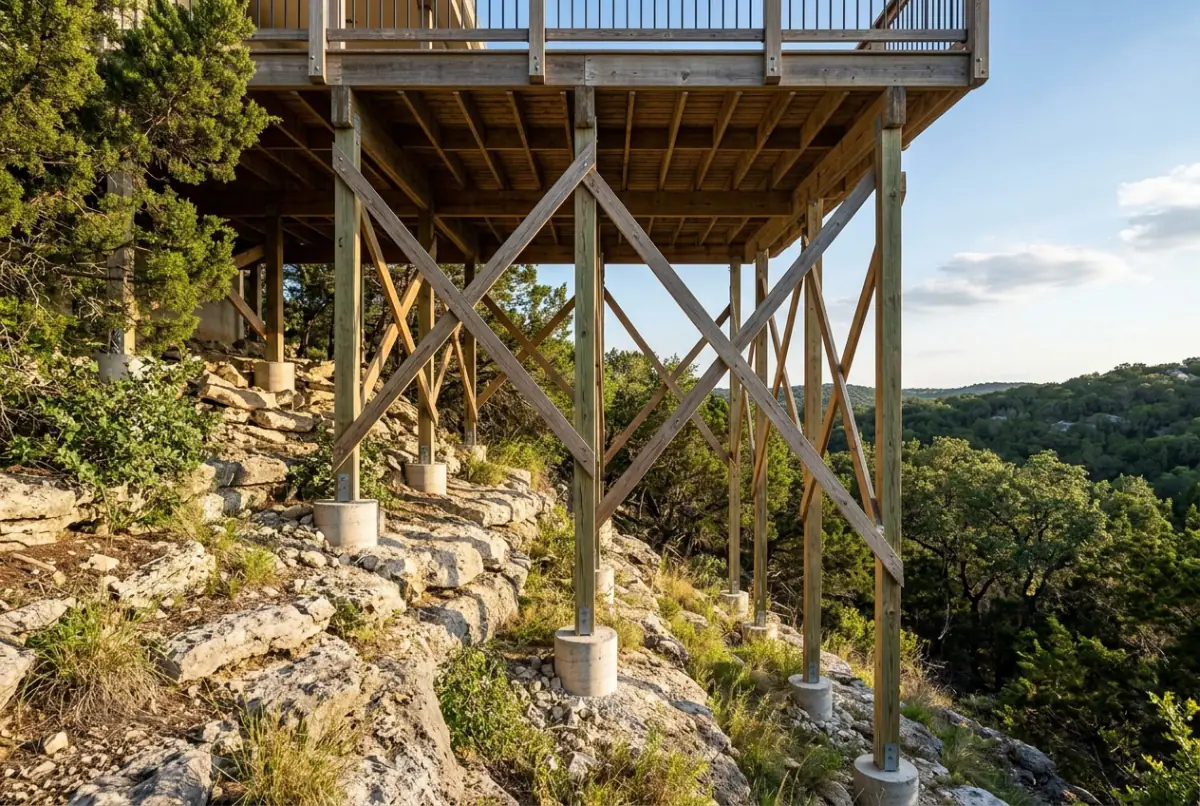
A guard is required on any open side of a walking surface that sits more than 30 inches above the surface below. Fine Homebuilding explains the detail that catches sloped lots. The drop counts at any point within 36 inches horizontally of the edge, not only straight down.
That reach matters on Austin lots. West of MoPac and out toward the lake, many backyards fall away from the house. A deck can feel low at the back door and still need a guard on the far side.
Take a worked example. A deck sits 24 inches above the ground at the door. The yard drops another 8 inches within 3 feet of the far edge. That edge now has a 32 inch drop, so it needs a guard, even though the door side does not.
Measure every open side, then measure 36 inches out from each one. The lowest spot decides the rule for that side.
Benches and planters can serve as the guard. They still have to meet the same height and strength rules as a rail.
Height, Gaps and Strength
Required deck guards must be at least 36 inches tall, measured from the walking surface to the top of the guard. On the open side of a stair, the guard can be 34 inches, measured from the line that connects the stair nosings.
The gap rule is the 4 inch ball. No opening in a required guard may let a 4 inch sphere pass through. At the open sides of a stair, the limit loosens slightly to 4 3/8 inches.
Strength comes from the load table. The 2024 code, Table R301.5, says a guard must resist 200 pounds applied at any point along the top, in any direction. The infill, such as balusters or panels, must resist 50 pounds on one square foot.
A rail that is not required does not have to meet the height or gap rules. Most owners build to them anyway, because kids and dogs do not read code books.
Stair Guards vs Stair Handrails
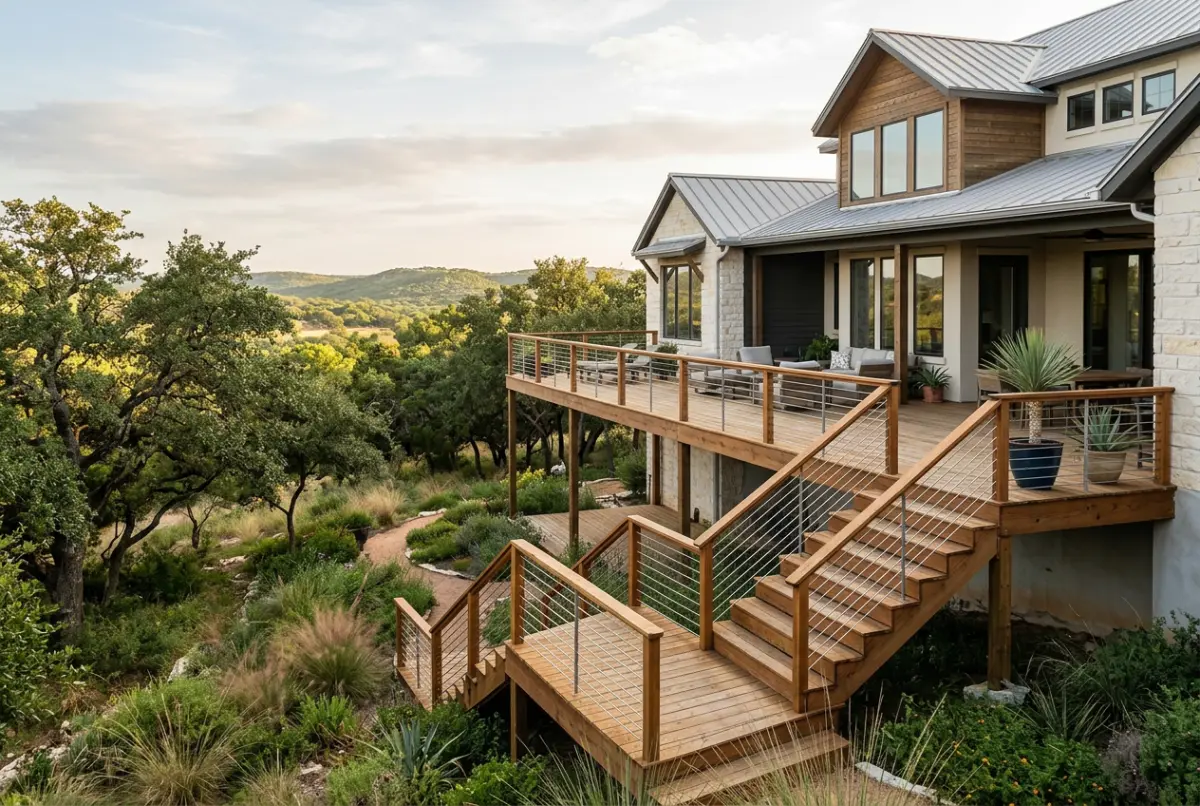
These are two separate rules, and they are triggered by different things. A stair guard follows the height of the fall. A handrail follows the number of steps.
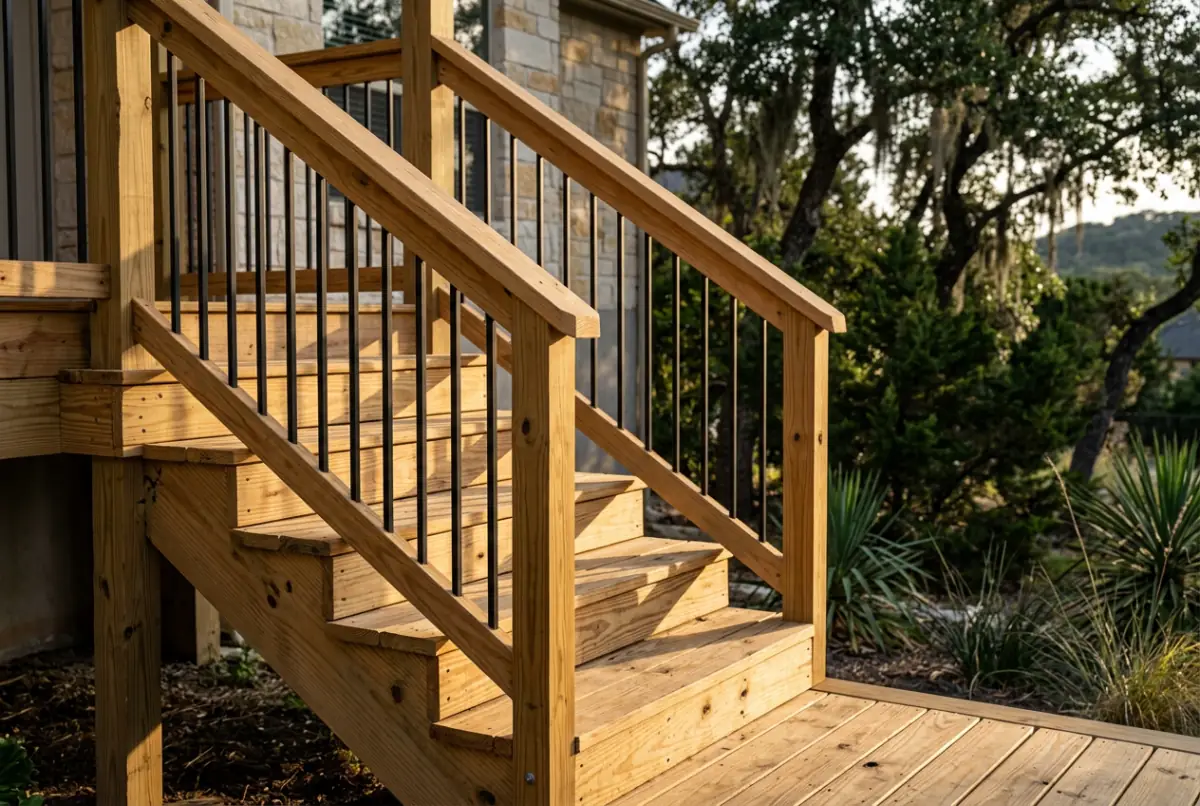
A stair with four or more risers needs a handrail on at least one side. It must sit 34 to 38 inches above the line of the nosings. A plain round handrail can be no more than 2 inches across, so a hand can close around it.
The top of a stair guard can double as the handrail. When it does, it has to land inside that 34 to 38 inch range.
Another worked example helps. A deck 21 inches up with three 7 inch risers needs no handrail by count. It also needs no stair guard, since the fall stays under 30 inches.
Posts That Actually Hold
Most failed rails do not fail at the top. They fail where the post meets the deck framing. The 2021 code added a deck guard section, summarized in a Penn State housing center handout.
- Load path. Guard loads must travel into the deck joists through a continuous connection.
- Side mounted posts. The joist or beam the post bolts to must be tied to the joists beside it, so it cannot roll.
- No end grain alone. Fasteners that rely only on pulling out of end grain are not allowed.
- No notched 4x4 posts. A 4x4 guard post may not be notched where it meets the framing.
- Composite rails. Plastic composite guards and handrails must meet ASTM D7032.
Ask any builder how each post ties into the joists. A good answer names blocking, bolts or a tested bracket, not nails.
Permits for Rail Work in Austin
The city exempt work list lets you replace deck boards without a permit. That exemption stops at guardrails and handrails, which the same ordinance spells out. New rails on an existing raised deck usually need a building permit.
A small deck that passes all five exemption tests, including 30 inches or less at every point, is exempt as a whole. Those five tests are covered in the Austin deck permit rules guide.
Exempt work still has to meet code. So a rail on an exempt deck should still be built to the numbers on this page.
The Gaps
Most railing answers stop at 36 inches and the 4 inch ball. They skip the 36 inch horizontal reach of the 30 inch rule, which is exactly what catches sloped Austin yards. They also cite the old R312 section, so a reader looking in the 2024 book finds the guard rules under R321 instead. Few of them mention the post connection, where rails really fail, or that Austin only exempts board swaps, not rail work. If the deck is also high off a slope, the builder vs DIY guide covers the footings and ledger that sit under those rails.
Answers in a Sentence
How high does a deck railing have to be in Austin?
A required guard must be at least 36 inches above the deck surface.
When is a railing required on a deck?
When the deck is more than 30 inches above the ground at any point within 36 inches of its open edge.
What is the 4 inch rule for deck railings?
No opening in a required guard may let a 4 inch ball through, with 4 3/8 inches allowed at the sides of stairs.
How many steps before a handrail is required?
Four or more risers need a handrail on at least one side, set 34 to 38 inches above the nosings.
Do I need a permit to replace deck railings in Austin?
Usually yes, because the board only repair exemption leaves out guardrails and handrails, unless the whole deck is small and low enough to be exempt.
Where We Got This
- Building Technical Codes, City of Austin Development Services Department
- City of Austin ordinance adopting the 2024 Residential Code, City of Austin City Council
- 2024 IRC Chapter 3 text, UpCodes, UpCodes
- Guardrails vs. Handrails, Fine Homebuilding, Fine Homebuilding, by Glenn Mathewson
- 2021 IRC Residential Deck Code Provisions, webinar handout, Pennsylvania Housing Research Center, Penn State
- Work Exempt from Building Permits, City of Austin Development Services Department
Elsewhere on the Site
Where to Find Deck and Patio of Austin
706 W Ben White Blvd A, Austin, TX 78704
Get a Free Estimate
Tell us what you want built and we will call you back to set up a time to look at it. Estimates are free and written.
(737) 315-4184
Open every day, 9 AM to 5 PM